Main Content of the Evaluation on Cadmium Accumulation, Transport Characteristics and Cadmium Tolerance of Different New Ramie Lines
Jump to section
I. Research Background and Objectives
- Cadmium (Cd) has strong biotoxicity and can easily harm human health through the food chain. Soil Cd contamination is the most severe among heavy metals in China. Remediation of heavy metal pollution is an important issue for agricultural safety and sustainable development.
- Phytoremediation technology stands out due to its low cost and eco-friendliness, but existing hyperaccumulator plants have limitations such as slow growth, small biomass, and low economic value.
- Ramie (Boehmeria nivea L.) has well-developed roots, large biomass, strong stress resistance, high economic value, and significant tolerance and adsorption capacity for heavy metals, showing great application potential in phytoremediation.
- This study aims to evaluate the Cd accumulation, transport characteristics and Cd tolerance of 5 new ramie lines (H1-H5) with Zhongzhu No.1 (Z1) as the control, providing scientific reference for breeding new ramie varieties specialized in heavy metal remediation.
II. Research Materials and Methods
(I) Experimental Materials
- Test materials: Zhongzhu No.1 (Z1, a main cultivar in Hunan with strong Cd tolerance and accumulation capacity) and 5 new ramie lines (H1-H5, with stable agronomic traits and good stress resistance).
- Cd stress reagent: CdCl₂•2.5H₂O, with a set Cd²⁺ concentration of 40mg/L.
(II) Experimental Methods
- Hydroponic experiment: Ramie lateral branches were cut and rooted hydroponically before Cd stress treatment. The control group was not supplemented with Cd. The culture conditions were set at 24-26℃, light intensity of 300µmol/m²/s, and light cycle of 14h light/10h dark.
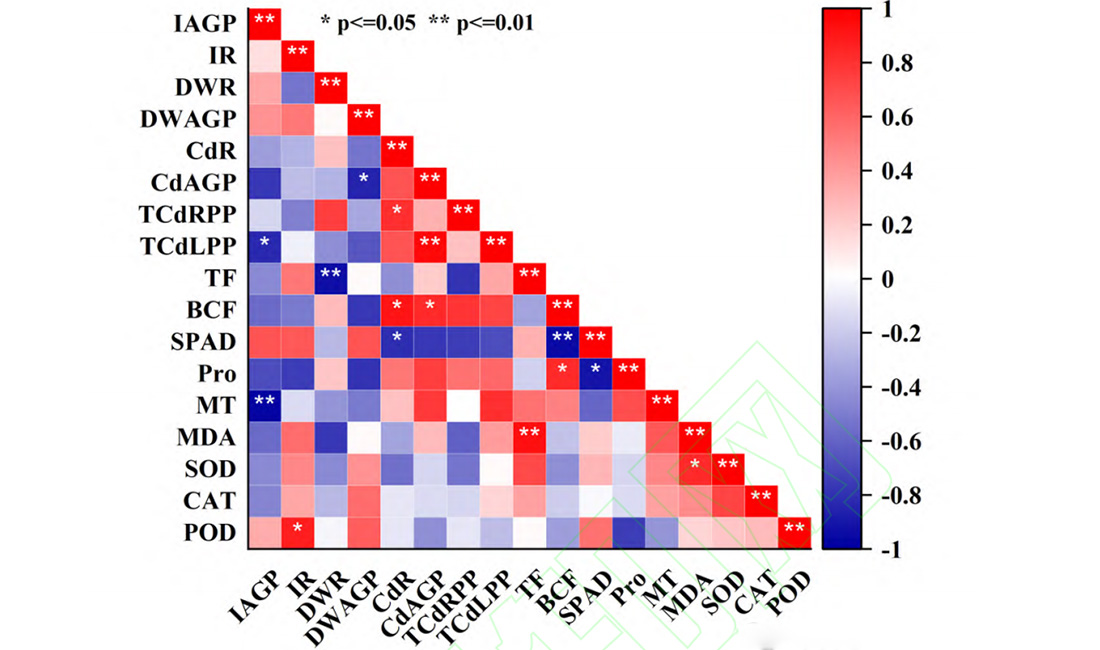
- Determination indicators: Plant height, root length, and leaf SPAD value (relative chlorophyll content) were measured regularly after treatment. After 15 days of treatment, biomass (aboveground and underground dry weight), physiological and biochemical indicators (proline (Pro), malondialdehyde (MDA), etc.), and Cd accumulation and transport-related indicators (transport factor (TF), bioconcentration factor (BCF)) were determined.
- Data processing: Membership function analysis and principal component analysis were used to comprehensively evaluate the Cd tolerance and Cd accumulation capacity of each material.
III. Core Research Results
(I) Effects of Cd Stress on Ramie Growth
- Cd stress significantly inhibited the growth of aboveground and underground parts of all test materials, reduced biomass accumulation, and caused wilting and even death of some plants.
- After 15 days of Cd stress, the root length growth of the 5 new lines was higher than that of Z1 (H1 was the highest, 203.43% higher than Z1), and the biomass ranking was H1>H4>H5>Z1>H3>H2.
(II) Changes in Physiological and Biochemical Indicators
- Leaf SPAD value: All materials decreased under Cd stress, with Z1 having the largest decrease (29.47%), and the new lines having smaller decreases. The ranking was H1>H5>H4>H2>H3>Z1.
- Antioxidant system: Z1 had the most significant increase in Pro content (647.54%); H1 had the most significant increase in CAT activity (248.86%); SOD and POD activities increased to varying degrees under Cd stress.
(III) Cd Accumulation and Transport Characteristics
- The Cd concentration in underground and aboveground parts, and the total Cd accumulation per plant were the highest in Z1, and all new lines were lower than Z1.
- Transport factor (TF): H1 was the highest, 132.86% higher than Z1; Bioconcentration factor (BCF): Z1 was the highest, and all new lines were lower than Z1.
(IV) Comprehensive Evaluation Results
- Cd tolerance ranking: H4>H5>H1>H3>H2>Z1 (H4 had the strongest Cd tolerance).
- Cd accumulation capacity ranking: Z1>H3>H2>H1>H4>H5 (Z1 had the strongest accumulation capacity).
IV. Research Conclusions
This study clarified the differences in Cd tolerance and Cd accumulation capacity among 6 ramie materials. H4 showed the strongest Cd tolerance, while Z1 still maintained the strongest Cd accumulation capacity. The research results enriched the resources of heavy metal remediation plants and provided a scientific basis for targeted breeding of new ramie varieties specialized in heavy metal remediation. Further verification of the field heavy metal remediation capacity of the new lines is needed in the future.

Chisato Ogino
Chisato Ogino, from Kaga City, Ishikawa Prefecture, is a graduate of Kanazawa Gakuin College and the College of Fashion Designers. With extensive experience in apparel design and premium textile development, she has served as Chief Designer at Sanyo Corporation (VINVERT) and collaborated with leading brands such as MUJI, World, and CHISATO PLANNING.
Chisato specializes in innovative material research and exhibition planning for major companies and has also worked as a consultant and lecturer for industry organizations.
Want to Know More About Our Products?
View All Products Now