Main Content of the Study on the Function of Ramie BnGCL1 Gene in Responding to Drought Stress
{acf_blog-txt}
Main Content of the Study on the Function of Ramie BnGCL1 Gene in Responding to Drought Stress
I. Research Background and Objectives
- Drought is a major abiotic stress affecting plant growth, which inhibits growth, reduces photosynthetic efficiency, and induces metabolic disorders. As a unique bast fiber crop in China, ramie (Boehmeria nivea L.) has strong drought resistance, but drought still impacts its yield and quality.
- Glutamate-cysteine ligase (GCL), also known as γ-glutamyl cysteine synthetase (γ-GCS), catalyzes the biosynthesis of glutathione (GSH). GSH plays a key role in plant antioxidant defense and maintaining redox homeostasis, while research on plant GCL genes remains limited.
- This study aims to explore the functional mechanism of the ramie BnGCL1 gene under drought stress, providing a theoretical basis and candidate gene for the research on ramie drought-resistant molecular mechanisms and the breeding of drought-resistant varieties.
II. Research Materials and Methods
(I) Experimental Materials
- Ramie variety: Zhongzhu No.1; Arabidopsis thaliana Col-0 and related vectors (pCAMBIA1300-35S-BnGCL1-myc, etc.) were preserved in the laboratory.
- Agrobacterium tumefaciens GV3101 and Escherichia coli strains TOP10, DH5α were purchased from Shanghai Weidi Biotechnology Co., Ltd.
(II) Core Research Methods
- Bioinformatics analysis: Tools such as NCBI and ExPASy were used to analyze the ORF, physicochemical properties of the protein, conserved domains, and species homology of the BnGCL1 gene.
- Expression pattern analysis: 20% PEG-200 was used to simulate drought stress, and qPCR was employed to detect the expression level of the BnGCL1 gene in ramie leaves at different time points.
- Overexpression verification: An overexpression vector was constructed and transformed into Arabidopsis thaliana. After screening positive lines, the phenotype, physiological indicators, and expression of drought-resistant related genes of plants under drought stress were determined.
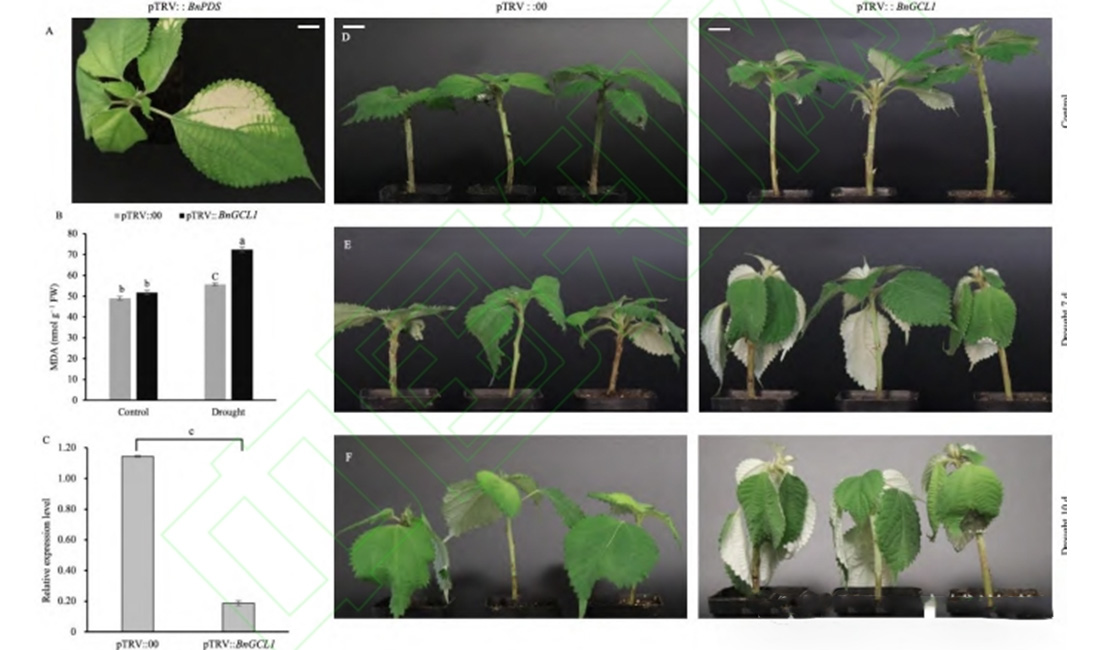
- Silencing verification: The pTRV-VIGS system was used to silence the BnGCL1 gene in ramie, and changes in plant phenotype and MDA content under drought stress were observed.
III. Core Research Results
(I) Characteristics of the BnGCL1 Gene
- Gene sequence: The ORF is 1581 bp, encoding 526 amino acids; the protein has an isoelectric point of 5.79, a molecular weight of 59,123.98 Da, is a stable protein, and contains a conserved PLN02611 domain.
- Homology: The amino acid sequence similarity with Nicotiana tabacum, Arabidopsis thaliana and other plants exceeds 80%, and it has the closest genetic relationship with Arabidopsis thaliana and Brassica juncea.
- Expression pattern: It is expressed in roots, stems, and leaves of ramie, and the expression level peaks at 12 hours of drought stress, which is 3.62 times higher than that before treatment.
(II) Drought Resistance Effect of Overexpressing BnGCL1
- Phenotype: Under drought stress, the root length of overexpressed Arabidopsis thaliana increased by 28.92%-57.23%, and the fresh weight increased by 81.42%-131.19%, showing better growth than the wild type.
- Photosynthetic pigments: The content of chlorophyll a increased by 25.07%-99.09%, and the content of chlorophyll b increased by 11.14%-47.26%, resulting in more stable photosynthetic capacity.
- Physiological indicators: The activities of antioxidant enzymes such as APX and γ-GCL were significantly increased, the content of GSSG was increased, and the activity of SOD was improved, enhancing the ability to scavenge reactive oxygen species; the contents of Pro and GSH decreased, which is speculated to be related to metabolic redistribution or consumption.
- Gene expression: It significantly upregulated drought-responsive genes such as AtGST1, AtGST11, AtNCED3, and AtWRKY40, involving antioxidant and ABA signaling pathways.
(III) Effects of Silencing BnGCL1
- Under drought stress, the leaves of silenced lines showed more obvious wilting, and the MDA content was significantly higher than that of the control, indicating a significant decrease in drought resistance, which confirms the drought-resistant function of BnGCL1.
IV. Research Conclusions
The BnGCL1 gene participates in plant drought stress response by enhancing antioxidant enzyme activity, regulating the metabolism of osmotic adjustment substances, and upregulating the expression of drought-responsive related genes, thereby significantly improving plant drought resistance. This gene provides an important candidate gene for the molecular breeding of drought-resistant ramie and also provides a reference for the drought resistance improvement of other crops.

Chisato Ogino
Chisato Ogino, from Kaga City, Ishikawa Prefecture, is a graduate of Kanazawa Gakuin College and the College of Fashion Designers. With extensive experience in apparel design and premium textile development, she has served as Chief Designer at Sanyo Corporation (VINVERT) and collaborated with leading brands such as MUJI, World, and CHISATO PLANNING.
Chisato specializes in innovative material research and exhibition planning for major companies and has also worked as a consultant and lecturer for industry organizations.
Want to Know More About Our Products?
View All Products Now